
I CAN’T AFFORD THAT
We had 12 guys at our latest Speak Up Cambridge Men’s Group, including three new guys, which made it our biggest night so far.
The topic written on the handout was “I Can’t Afford That.”
We barely talked about money for the first hour and a half.
And that probably says quite a lot about what Speak Up is actually like. I normally bring a topic because it gives us somewhere to begin, but the conversation doesn’t have to stay inside the lines. This particular night moved through suicide, connection, expectations, affirmations, spooning, relationships, money and eventually a metaphor about tuning a radio.
On paper, those things don’t necessarily sound like they belong together. Looking back afterwards, I think they probably did.
WHEN A MONEY CONVERSATION BECOMES SOMETHING ELSE
The night went somewhere much deeper pretty quickly when the conversation opened into suicide and what happens when somebody is trying to find help but still doesn’t really know where to go or what to do next.
Once that door opened, it became obvious how many men could relate in some way. Some had been in that place themselves years ago, some had experienced suicidal thoughts, and others had lost somebody or been close to someone who had struggled.
One man who had been there himself described how differently he sees those thoughts now. His way of looking at it today was basically, “We’re all going to die eventually anyway, so why speed it up?” For him, the thoughts could now be acknowledged without automatically needing to be followed.
That was his way of making sense of his own experience, not an answer for everybody. But it opened a bigger question about what might actually be underneath the desire to escape.
Connection became a big part of that conversation. When we looked around the room at how many male friends we could genuinely call when life was shit and know they would be there, for most of us the answer was only one or two.
There was something pretty confronting in that.
We can spend a lot of our lives trying to create connection through relationships, work, achievement, helping other people, being useful, staying busy or simply being the person everyone else can rely on. None of those things are necessarily bad, but we can become very good at helping everybody else while barely noticing that something in us is asking for help too.
A lot of men are comfortable being useful. We can fix something, solve something, carry something or turn up for somebody else. Saying, “Actually, I’m struggling and I need somebody here with me,” can be a completely different challenge.
THE CONTRACT NOBODY ELSE SIGNED
From connection, the conversation naturally moved into expectations and the gap between what happens and what we thought should have happened.
A really simple example is cooking dinner. Imagine I decide to cook, and somewhere inside my head I also decide that because I cooked, my partner should do the dishes. It sounds completely reasonable to me.
The only problem is that I never told her.
I’ve created a contract in my head that the other person never signed.
Dinner finishes, the dishes sit there, and I start getting pissed off because she hasn’t done what she was supposed to do. Meanwhile she may have absolutely no idea that there was an expectation in the first place.
We do this with much bigger things than dishes. We carry expectations about partners, kids, friends, work and ourselves, and sometimes our reaction isn’t only about what just happened. It is also about the gap between what happened and the version we had already decided should happen.
That is where becoming curious about what is underneath the reaction can change the conversation. The dishes may be the visible problem, but underneath it might be wanting support, feeling unappreciated, expecting somebody to notice what we need without us saying it, or something else entirely.

Sometimes we get angry when somebody breaks a contract they never knew they signed.
WHAT ARE YOU ASKING YOUR MIND TO FIND?
From there, the conversation shifted into positive affirmations and how differently the day can feel when we deliberately put our attention somewhere useful.
I’ve always found some affirmations easier to work with than others. If I stand there saying, “I have a million dollars,” there can be another voice inside my head immediately answering, “No you bloody don’t.”
So sometimes I turn the statement into a question instead. Rather than “I have a million dollars,” it might become, “Why do I have abundance in my life?” If connection is what I’m looking for, maybe it becomes, “Why do I have people around me who support me?”
For me, the interesting part is what the question directs my attention towards. If the question I repeatedly ask is, “Why is my life so shit?” then I can become pretty bloody good at collecting examples that support it. That doesn’t mean ignoring pain or pretending everything is wonderful. It just means noticing what I continually ask myself to look for.
And that led to one of the funniest and probably most useful parts of the night.
THE PEN, THE SPOON AND THE KNIFE
I picked up a pen and held it in front of the group. If I keep saying, “I don’t want this pen. I don’t want this pen. I really don’t want this bloody pen,” where is all my attention going?
Straight onto the pen.
I might be talking about getting rid of it, but I’m still completely focused on the thing I don’t want.
So I changed it and said, “What I actually want is a spoon.”
There was a teaspoon sitting on the table, and in my head I was hoping somebody would notice it and hand it to me. Instead, the conversation immediately went to spooning in the bedroom. Who wanted to spoon who, who was going to be the little spoon — pretty much exactly where you would expect a group of blokes to take it.
At the time I was thinking, “That’s not what I bloody meant.”
It wasn’t until afterwards that I realised they had actually given me exactly what I asked for.
I said spoon.
I hadn’t said teaspoon.
The picture in my head was perfectly clear to me, but I hadn’t actually communicated it. Then the next response was, “Well, I haven’t got a spoon, but I’ve got a knife.”
Again, not what I had pictured, but by then everybody’s attention had changed. Nobody was focused on the pen anymore. We were looking in the direction of what I had said I wanted.
There’s something in that about life. We can say we want something while still being pretty vague about what that actually means. Then something turns up that technically fits what we asked for, but because it doesn’t look like the picture in our head, we don’t recognise it.
For me, it isn’t about pretending you can ask for anything and it will magically appear exactly as imagined. It is more about getting clearer about what you actually want, putting your attention in that direction, and then being awake enough to notice what starts appearing around it.
Sometimes what turns up might even show us that we weren’t as clear about the request as we thought we were.
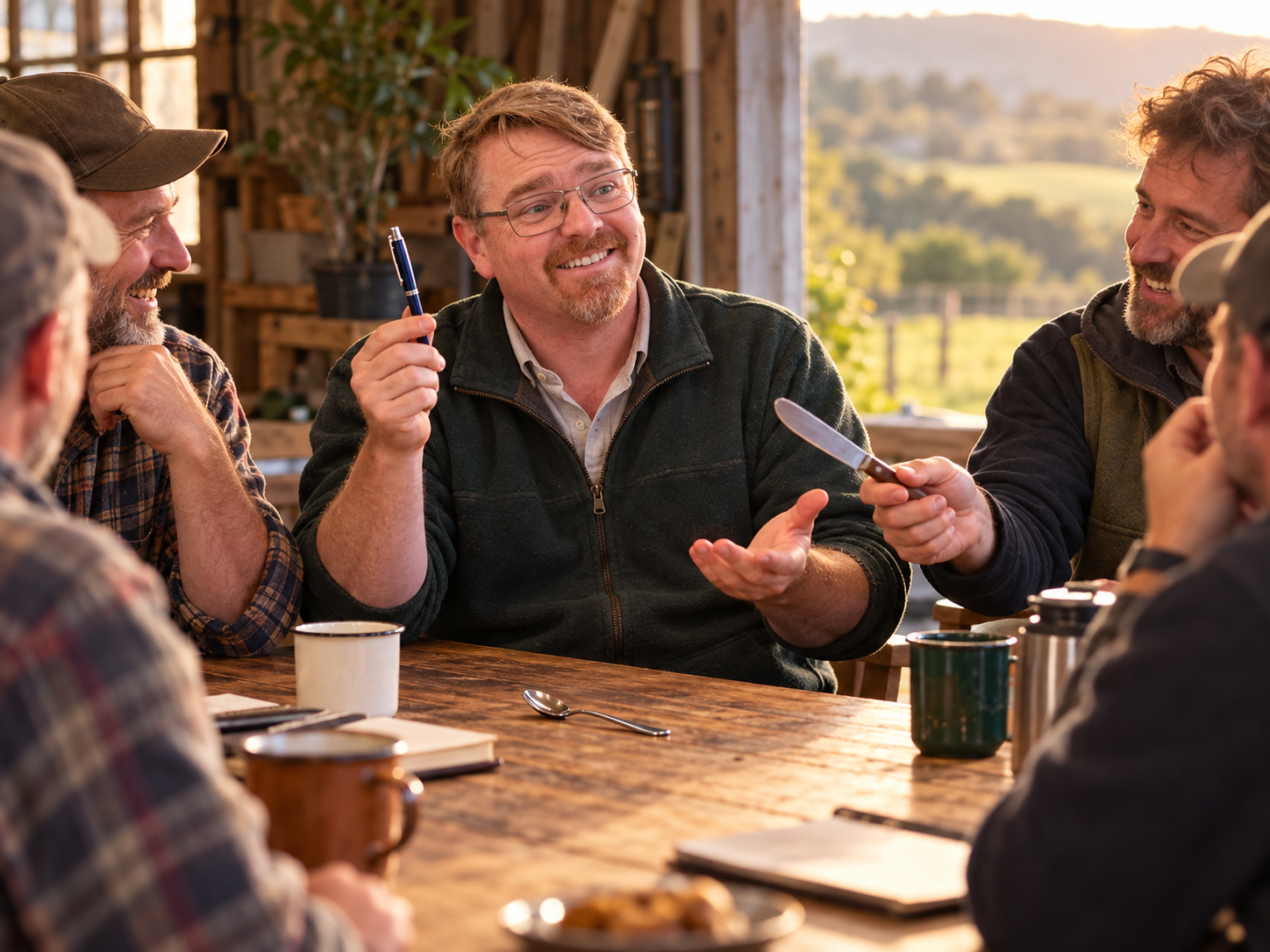
I asked for a spoon. I just wasn’t very bloody specific about which sort.
THE HAILSTORM AND THE TURTLE
The same sort of loop showed up when the conversation moved into relationships.
There is a relationship dynamic often described as the Hailstorm and the Turtle. The Hailstorm moves towards conflict. Something feels wrong and they want to talk about it, ask questions, get answers and sort the bloody thing out. If they don’t feel heard, they can push even harder.
The Turtle tends to go in the opposite direction. As the intensity rises, they pull inward. They may go quiet, struggle to find the words, shut down or want to get away from the conversation. They can look calm from the outside while internally they may be completely overwhelmed.
The interesting part is how well the two responses reinforce each other. The Turtle retreats, so the Hailstorm thinks, “You’re not listening to me,” and pushes harder. The Hailstorm pushes harder, so the Turtle thinks, “See, I can’t say anything without being attacked,” and retreats further.
Both people may be trying to make themselves feel safer, while the way each one does it makes the other person feel less safe.
That is where listening to understand rather than listening to reply becomes important. Most of us know what it’s like to be halfway through listening while already constructing our defence, explanation or solution. Technically we’re hearing the words, but really we’re just waiting for our turn.
Sometimes simply reflecting back what you think the other person is saying can slow the whole thing down. “So what I’m hearing is that when I did that, you felt like I wasn’t listening. Is that actually what you mean?”
They might say yes. Or they might hear their own words back and realise that wasn’t really what they meant at all.
The same applies when somebody needs some space. There is a big difference between disappearing and saying, “I need to go for a walk because I’m too wound up to talk properly, but I will come back and we’ll keep talking.”
The important bit is actually coming back.
Otherwise the Hailstorm learns that giving the Turtle space means the conversation disappears, and next time they may push even harder. Once again, the thing each person does to protect themselves can end up strengthening exactly the pattern they don’t want.

The harder the Hailstorm pushes, the further the Turtle retreats.
AND EVENTUALLY WE GOT BACK TO MONEY
After going a pretty bloody long way around, we finally made it back to the topic written on the handout.
“I can’t afford that.”
By then it didn’t actually feel like a separate conversation.
Sometimes “I can’t afford that” is simply true. There isn’t enough money available for whatever is in front of us. But it can also become such an automatic phrase that we stop noticing what it is doing to the way we see our choices.
I can’t afford that. I can’t afford that. I can’t afford that.
What happens if the language changes slightly to, “I’m choosing not to spend my money on that right now”?
The bank balance hasn’t magically changed. We aren’t pretending the money exists when it doesn’t. But one version leaves me with no choice while the other asks me to take some ownership over where I’m choosing to put what I do have.
A great example came up around two neighbouring houses. One is a massive, beautiful home with a fairly basic little Ford Focus sitting outside. Next door is a pretty average house with two Porsches parked in the driveway.
Which one has more money?
We have absolutely no bloody idea.
What we can see is that they have chosen different things. One appears to place more importance on the house, while the other clearly enjoys cars.
It reminded me of a line I used to hear on a podcast: “You can afford anything, but you can’t afford everything.”
I don’t take that literally to mean everyone can afford any purchase they can imagine. For me, the useful part is recognising that we’re constantly making choices about what matters enough to put our resources towards. Maybe the question is less about keeping up with somebody else’s version of a good life and more about deciding what actually matters to us.
CHANGING THE STATION
That idea of choice eventually led into another metaphor.
I think we’re a bit like radios.
From the time we’re born, life starts tuning us. Family, school, community, relationships, successes, failures and all of our experiences contribute to what eventually starts feeling normal.
After a while, we’re tuned into a particular station.
Then we decide we want something different. Maybe we want to earn more money, build a business, change careers, have a different kind of relationship, set a boundary we’ve never set before or simply stop living in the same old way.
We turn the dial and suddenly it sounds wrong.
Not necessarily bad. Just unfamiliar.
And familiarity has a pretty strong pull, so it can be tempting to turn straight back to the station we know.
I think that works in both directions. Someone who is used to a certain amount of stability might also work bloody hard to get back there if everything falls apart, because living on the street or losing everything doesn’t fit their sense of what is normal either. We seem to develop a range that feels like “me,” and moving outside that range can feel uncomfortable regardless of which direction we’re heading.
Sometimes the life we say we want requires us to tolerate feeling a little out of tune for a while.
Maybe we move one note. Maybe we move a whole octave. It can still be our song, just at a different pitch.
UNDERSTAND, RELEASE, LIVE
Looking back over the whole night, this is probably where I see the common thread.
First comes understanding. What is actually happening here? What am I reacting to? What expectation did I have? What keeps repeating? Am I the Hailstorm or the Turtle in this particular conversation? What am I continually focusing on? Is “I can’t afford that” simply describing today’s bank balance, or has it also become part of a much bigger story about what I believe is possible for me?
Understanding gives us a chance to see something that was previously happening automatically.
But understanding something doesn’t always make it disappear. We can know exactly why we react the way we do and still find ourselves doing it when the right button gets pushed. That is where Release comes in — working with whatever seems to be holding that reaction, belief or protective response in place so it has less automatic control over what happens next.
And then eventually comes Live.
If I’m not going to spend my whole life organising myself around what I don’t want, what do I actually want instead?
That question probably ties this entire night together better than the original topic did.
It also ties pretty closely into the work I do outside the group.
I help men who feel like they should have everything together understand why life keeps feeling harder than it should, so they can move towards what they really want.
A man might arrive because his relationship keeps ending up in the same argument, his mind won’t switch off, money always feels tight, he keeps getting pissed off more than he wants to, or he simply has that feeling that life shouldn’t be this bloody hard when, from the outside, everything looks mostly okay.
Whatever brings him through the door gives us somewhere to start.
Then we get curious about what might actually be happening underneath it.
COME AND SEE FOR YOURSELF
That is probably the best way I can describe Speak Up Cambridge too.
I bring a topic along, but the topic is really only the doorway. Nobody has to stay inside it, and nobody needs to arrive with some perfectly prepared story about what is wrong with their life. Sometimes you contribute. Sometimes you listen. Sometimes the conversation is bloody heavy, and five minutes later somebody has managed to turn a teaspoon into a discussion about spooning.
That’s the group.
If you’re a man around Cambridge and you’ve wondered what actually happens at one of these nights, come along and see for yourself. You don’t need a massive problem, and you don’t need to know what you’re going to say before you arrive.
And if something in this reflection has made you recognise one of your own repeating reactions or situations and you’d rather explore it privately, that is also the work I do one-to-one at The Healing Barn. We start with whatever is happening for you, understand what may be sitting underneath it, work with what is keeping it in place, and begin looking at what you actually want to move towards.
You can book a 60-minute session with me here:
https://thehealingbarn.as.me/work-with-scott
IF THIS PART OF THE CONVERSATION HIT CLOSE TO HOME
If you’re having suicidal thoughts or you’re worried you may act on them, please don’t try to carry that on your own. In New Zealand, you can call or text 1737 any time for free, confidential brief emotional support from trained counsellors and peer support workers. If you or somebody else is in immediate danger of harming themselves or someone else, call 111.
