
WHY DOES EVERYTHING FEEL LIKE A FIGHT?
WHY DOES EVERYTHING FEEL LIKE A FIGHT?
The topic for our latest Speak Up Cambridge Men’s Group was “Why does everything feel like a fight?” It started from something I’d noticed in some work I’d been doing during the week, where another person was trying very hard to control what was happening around her so that she could feel okay inside. Other people needed to behave a certain way, understand things a certain way and respond in a way that worked for her, otherwise it became frustrating.
What I noticed for myself was how easy it would have been to get caught in that fight as well. I could argue with her, try harder to make her see what I was seeing, or take responsibility for fixing something that actually wasn’t mine to fix. There were things I could point out and things I could offer, but ultimately some of what was happening belonged to her to work out.
That was where I used the idea of giving your power away. If somebody else has to behave a certain way before I can feel okay, I’ve given them quite a lot of control over how I feel. That doesn’t mean people can’t hurt us, piss us off or trigger something in us. Of course they can. It also doesn’t mean we should somehow be happy all the time. If I’m angry, I’m allowed to be angry. If I’m sad, I’m allowed to be sad. But there’s a difference between feeling what is genuinely happening in me and needing the other person to change before I can be okay again.
That became the thread that seemed to run through most of the night.

The harder the Hailstorm pushes, the further the Turtle retreats.
HOW MUCH ARE YOU TRYING TO FORCE?
The conversation moved pretty quickly into masculine and feminine energy. We weren’t talking about men being masculine and women being feminine. We were talking more about two different ways of moving through life. One side is doing, directing, pursuing, giving, fixing and trying to make something happen. The other is allowing, receiving, making room and letting something come towards you.
We need both.
A lot of us blokes are pretty comfortable with the doing side. If there’s a problem, fix it. If somebody is upset, sort it out. If a relationship doesn’t feel right, talk about it until it does. If something isn’t happening, work harder. There’s nothing wrong with any of those things, but there comes a point where doing turns into forcing, and forcing can make everything feel like a bloody fight.
That brought us back to the Hailstorm and the Turtle, something we’ve talked about before in the group. The Hailstorm senses something is wrong and moves towards it. “Tell me what’s happening. Let’s talk about it. What do we need to do? Why are you walking away?” The Turtle feels that pressure coming towards them and pulls back. They need more space, less noise and a chance to work out what is happening for themselves.
Then the cycle feeds itself. The further the Turtle retreats, the harder the Hailstorm pursues. The harder the Hailstorm pursues, the further the Turtle retreats. Neither person necessarily wants the fight, but both can become stuck in a way of responding that creates more of it.
As we were talking, I started thinking about it like breathing. There has to be an in-breath and an out-breath. You can’t just breathe out forever. Sometimes the Hailstorm can be so busy talking, fixing, doing and pushing that they almost take up all the air in the room. At some point they have to stop long enough to breathe in, listen and receive something back.
YES, APPARENTLY THAT COUNTS AS RECEIVING
That was roughly where one of the guys asked, “So if your girlfriend is giving you a blowjob, does that mean you’re in your feminine?”
It was one of those questions that could probably only come up at Men’s Group.
And in the way we were talking about it, yes. You’re receiving.
He immediately wanted to know whether that was going in the newsletter.
Obviously it was.
Underneath the joke, though, there was actually quite a useful point. Some people are incredibly good at giving and incredibly uncomfortable receiving. They’ll provide, help, fix, work, support and make sure everyone else has what they need, but if somebody gives them love, praise, help, attention or affection without them having to earn it first, they don’t really know what to do with it.
There needs to be a balance. If all I ever do is give, fix and push, eventually I’m breathing out with nothing coming back in. But if all I ever do is receive and never step forward, initiate or contribute, that isn’t particularly balanced either.
Sometimes the answer isn’t to do more. Sometimes it’s to stop long enough to receive what is already there.
Are you actually helping, or are you trying to help based on what you think the other person needs?
TRY TO PICK UP THE CHAIR
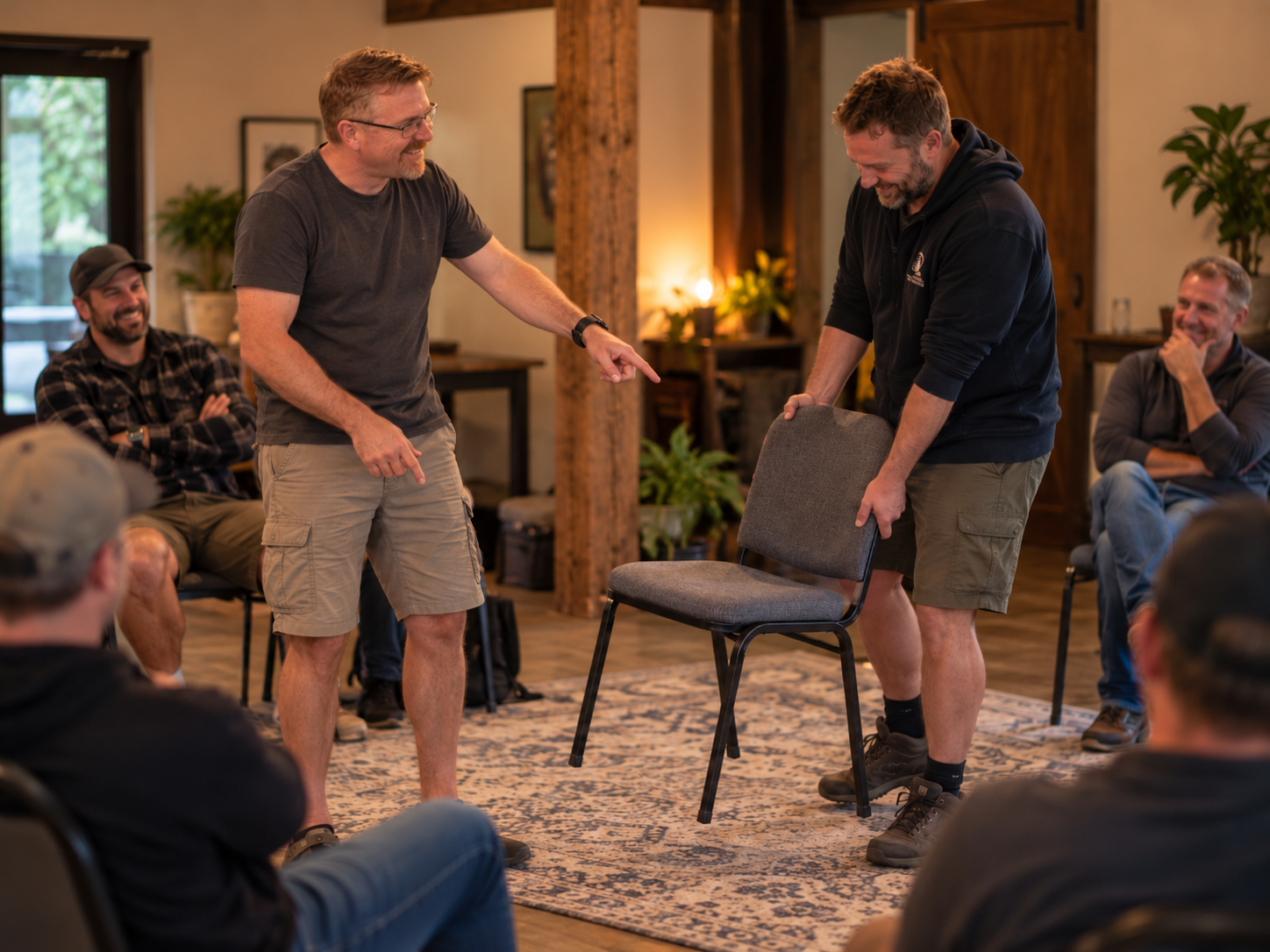
One of the guys was talking about how much he was trying to help his partner, so I got him to stand up and told him to try to pick up his chair.
He picked it up.
I told him he’d done it wrong and asked him to put it down and try again. So he picked it up again.
“No. You’re still picking it up. I want you to try to pick it up.”
Eventually he just stood there looking at me because there wasn’t actually anything else he could do. He either picked the chair up or he didn’t.
That was the point.
We often say we’re “trying to help” somebody, but what are we actually doing? Are we listening to what they’re asking for, or are we giving them what we think they should need?
Someone might say, “I just want to feel loved and safe,” and we hear that through our own experience. We think, “This is what would make me feel loved and safe, so I’ll do that for you.” We might be trying bloody hard, but if that isn’t what the other person is actually asking for, we can end up wondering why nothing is working.
The same thing came up around someone asking for space. “I need space” doesn’t necessarily mean “leave me completely alone.” It might mean I need some room to have something that belongs to me. Time for myself. My own interests. Some freedom to think or grow without feeling like somebody is constantly leaning over me trying to help.
Sometimes we don’t need to try harder. We need better information.
And sometimes we have to stop fixing long enough to actually hear it.
CAN YOU BE OKAY WHEN SOMEONE ELSE ISN’T?
The second half of the night took this in a slightly different direction when one of the guys talked about a pretty raw breakup he was going through. What seemed to be hurting him wasn’t only the relationship ending. He was also really worried about how much his partner was hurting.
That brought us back to the same question from the start of the night. Can you care deeply about somebody and still be okay when they aren’t?
That’s not the same as not giving a shit about them. If somebody we love is hurting, of course it affects us. But there’s a difference between caring about somebody’s pain and believing I’m not allowed to be okay until they are.
For some of us, that may be something we learnt very early.
If you grew up in a house where one person being angry, upset or unpredictable could change the feeling of the whole house, you probably got pretty good at reading the room. Is Mum okay? Is Dad pissed off? Have I done something wrong? What do I need to do to calm everything down?
As a kid, that can feel like safety. If everyone around me is okay, then I’m safe.
The trouble is that we can take that same rule into adult relationships. We become good at pleasing people, adjusting ourselves and keeping the peace. We know how to become whatever seems to make the relationship work.
Eventually, though, there’s a pretty important question underneath it:
Do I actually know who I am when I’m not trying to keep somebody else happy?
EVERYONE HAS A PLAN UNTIL THEY GET PUNCHED IN THE MOUTH
Mike Tyson’s quote came up during the night: “Everyone has a plan until they get punched in the mouth.”
That seemed to fit surprisingly well.
We can plan exactly how another person should respond. We can rehearse the conversation in our head, decide what we’re going to say and imagine what they’ll say back. But people don’t always follow the script.
Sooner or later somebody does something we didn’t expect.
If I’m connected to myself, that doesn’t mean their reaction won’t affect me. But it might mean I don’t immediately have to change who I am because they didn’t respond the way I hoped.
Somebody can disagree with me and I don’t necessarily have to abandon what I believe.
Somebody can be disappointed with my decision and it can still be the right decision for me.
Somebody can have an emotion without me immediately taking responsibility for making that emotion disappear.
That feels very different from constantly organising myself around everyone else.

Sometimes familiar feels safer than genuinely safe — even when we already know there’s a lion behind the door.
FAMILIAR DOESN’T ALWAYS MEAN SAFE
That led us into relationships, attachment and why we can sometimes keep getting drawn back towards something even when we know it wasn’t particularly good for us.
One of the ideas we talked about was the difference between something feeling safe and something simply feeling familiar.
I used the example of standing in front of two doors. Behind one door you know there’s a lion. Behind the other door you have absolutely no idea what is there.
Logically, you’d think we’d choose the unknown one rather than knowingly opening the door with the bloody lion behind it.
But sometimes the lion can feel safer.
At least you know that lion.
You know what happens when you open the door. You know how to respond. You’ve done it before.
Relationships can have some of that same familiarity. Maybe uncertainty is familiar. Maybe chasing someone is familiar. Maybe trying to earn love is familiar. Maybe never quite knowing where you stand feels strangely normal because you’ve spent a lot of your life feeling that way.
Then you meet somebody who is steady, secure and loving, and sometimes that doesn’t immediately feel safe at all.
It feels unfamiliar.
There’s nothing to chase. There isn’t a constant drama to fix. You’re not spending all your time trying to work out whether they still want you.
And sometimes we can push that away because the thing we recognise as “chemistry” might actually be familiarity.

You can’t fully move forward while using all your strength to hold onto the old branch.
LET GO OF THE OLD BRANCH
We talked about that like a monkey swinging between trees. To move forward, it has to let go of the branch behind it.
If it holds onto both branches, it doesn’t go anywhere.
It just hangs there.
And hanging there gets bloody tiring.
We can do the same thing after relationships. We leave, but keep checking what they’re doing. We replay conversations. We wonder whether we made the right decision. We keep one hand wrapped around the old relationship while trying to reach towards whatever comes next.
Sometimes it feels safer to hang there because at least we know the old branch can hold us.
Letting go doesn’t mean the relationship meant nothing or that you somehow shouldn’t care anymore. It just means recognising that at some point you can’t fully move forward while using all your strength to hold onto what is behind you.
WHAT IS THE OTHER PERSON SHOWING YOU?
The idea of relationships being mirrors came up as well.
One of the guys asked whether that meant if your partner is controlling, you must also be controlling.
Sometimes that might be the case, but I don’t think it’s always that simple.
A mirror reverses things too.
Maybe another person’s control shows you how little control you feel you have in your own life. Maybe somebody giving you huge amounts of attention and love at the beginning feels incredible because it fills something you have difficulty giving yourself. Maybe somebody withdrawing hits you really hard because there is already a part of you that is frightened of being left.
That doesn’t mean their behaviour is your fault, and it definitely doesn’t mean you should stay in a relationship that isn’t good for you because it’s supposedly there to teach you something.
Sometimes what it shows you might be that it’s time to leave.
But your reaction is still information.
Instead of only asking, “What the hell is wrong with them?” sometimes there’s something useful in asking, “Why does this hit me so hard?”
That’s where the mirror can become useful.
A FEW BOOKS THAT HAVE HELPED ME
We also got talking about some books I’ve listened to over the years that have made sense to me and helped me look at some of this differently.
Healing Your Attachment Wounds by Diane Poole Heller, No More Mr. Nice Guy by Robert A. Glover, and The Untethered Soul by Michael A. Singer were the three I mentioned on the night.
They’re very different books, and I’m not saying you need to agree with everything in them. They’re simply three that have helped me at different points in my own journey. If some of the conversation in this reflection has got you curious, they might be worth having a listen to and seeing what lands for you.
MAYBE THE FIGHT ISN’T WITH THE OTHER PERSON
Looking back on the night, I think this is where all the different conversations connected.
We can spend an enormous amount of energy trying to change the outside world so we can feel okay inside. We try to make somebody understand us, make them love us differently, stop them leaving, keep them happy, fix their problem or get them to respond in the way we need.
But sometimes the thing that’s actually being challenged isn’t the other person.
It’s something in us.
Maybe a belief that I’m not good enough.
Maybe a fear of being left.
Maybe I need to be useful to feel valuable.
Maybe I need everybody around me to be okay before I feel safe.
Maybe I’m holding onto something because it’s familiar, even though another part of me already knows I don’t want it anymore.
That doesn’t make everything your fault. It doesn’t mean the other person gets a free pass for whatever they do.
It just gives you somewhere you actually have some power.
You may not be able to control what the other person does.
You can become curious about what their behaviour brings up in you.

UNDERSTAND → RELEASE → LIVE
For me, this night fitted really closely with the way I’ve been developing my own work.
Understand is about seeing what is actually happening underneath the reaction. Why does this feel like such a fight? What feels threatened? What am I trying to control? What am I afraid will happen if I stop?
Release is about working with whatever is holding that old response in place rather than simply knowing intellectually that you shouldn’t react that way.
Then Live starts to become a different question.
What do I actually want?
Can I stay connected to myself when someone else is upset?
Can I give without needing to control what comes back?
Can I receive without feeling I need to earn it?
Can I stop hanging onto the old branch long enough to find out what might be available next?
I help men who feel like they should have everything together understand why life keeps feeling harder than it should, so they can move towards what they really want.
If something in this reflection sounds familiar — maybe the people-pleasing, the fixing, the chasing, the relationship that keeps pulling you back, or simply feeling like you’re constantly fighting to keep everything together — that’s the sort of thing we can explore one-to-one.
You don’t need to know exactly why you do it before you come in. Bring the thing that keeps happening and we can start there.
A 60-minute one-to-one session with me is $150.
Book here:
https://thehealingbarn.as.me/work-with-scott
WHAT SPEAK UP IS ACTUALLY LIKE
If you’ve never been to Speak Up Cambridge, this night probably gives you a pretty good idea of what happens.
We started by talking about why life can feel like a fight and somehow got through masculine and feminine energy, Hailstorms and Turtles, blowjobs, trying to pick up a chair, childhood, Mike Tyson, lions hiding behind doors, monkeys swinging through trees and relationship breakups.
Written down like that, it sounds pretty random.
But in the room it was all connected.
That’s what I enjoy about these nights. We don’t need to have everything figured out before we talk about it. One conversation leads into another, somebody shares something that changes the direction, somebody else makes an inappropriate joke when things get a bit too serious, and somewhere amongst all of it we usually end up seeing something about ourselves a little differently.
You don’t have to come along with a problem to solve, and you don’t have to speak if you don’t want to.
Sometimes just listening to another bloke talk about his life is enough to recognise something in your own.
