
How Men Lose Themselves in Relationships
How Men Lose Themselves in Relationships
Why familiar patterns can feel safer than healthy love.
At a recent Speak Up Cambridge men’s group, the theme was how men lose themselves in relationships.
It was a good night, with another four new men joining the room. What stood out to me was not just the topic itself, but how many different ways the same pattern can show up. We talked about trauma bonding, attachment, old emotions, farming metaphors, why change can feel unsafe, and why we often keep repeating the very patterns we say we want to leave behind.
The thread running through all of it was this:
Sometimes we do not lose ourselves all at once.
We lose ourselves slowly, inside familiar patterns.
The loop we get caught in
One of the things we talked about was the repeating loop that can happen in relationships.
Something happens and one person gets triggered. That trigger activates a coping mechanism. Maybe they shut down, get defensive, try to fix everything, get angry, please, withdraw, or try to control the situation.
But then that coping mechanism triggers the other person.
So they go into their own protection pattern, which then triggers the first person again. Before long, both people are no longer responding to what is actually happening in the moment. They are responding to each other’s survival patterns.
That is where relationships can become confusing.
On the surface, it might look like the argument is about the dishes, money, the kids, tone of voice, time, intimacy, or who said what. But underneath, something older is often being touched. The argument is not only about what happened. It is about what that moment represents to each person’s nervous system.
One person might feel abandoned. The other might feel controlled. One might feel criticised. The other might feel ignored. One might try harder to get connection, while the other pulls away to feel safe.
Then both people end up proving each other’s fear right.
The one who fears abandonment feels abandoned. The one who fears being controlled feels controlled. The one who fears not being enough feels like nothing they do is enough.
This is why it can be hard to simply “remember what to do” when we are triggered. When the nervous system is activated, the calm thinking part of the mind is not always the part running the show. We can know all the right words when we are calm, but when the old pattern takes over, the body reacts before the mind catches up.
That is why deeper work is not only about talking through the story. It is also about understanding the pattern underneath it: the body response, the nervous system, the wound that got touched, and the part of us that is trying to protect us.
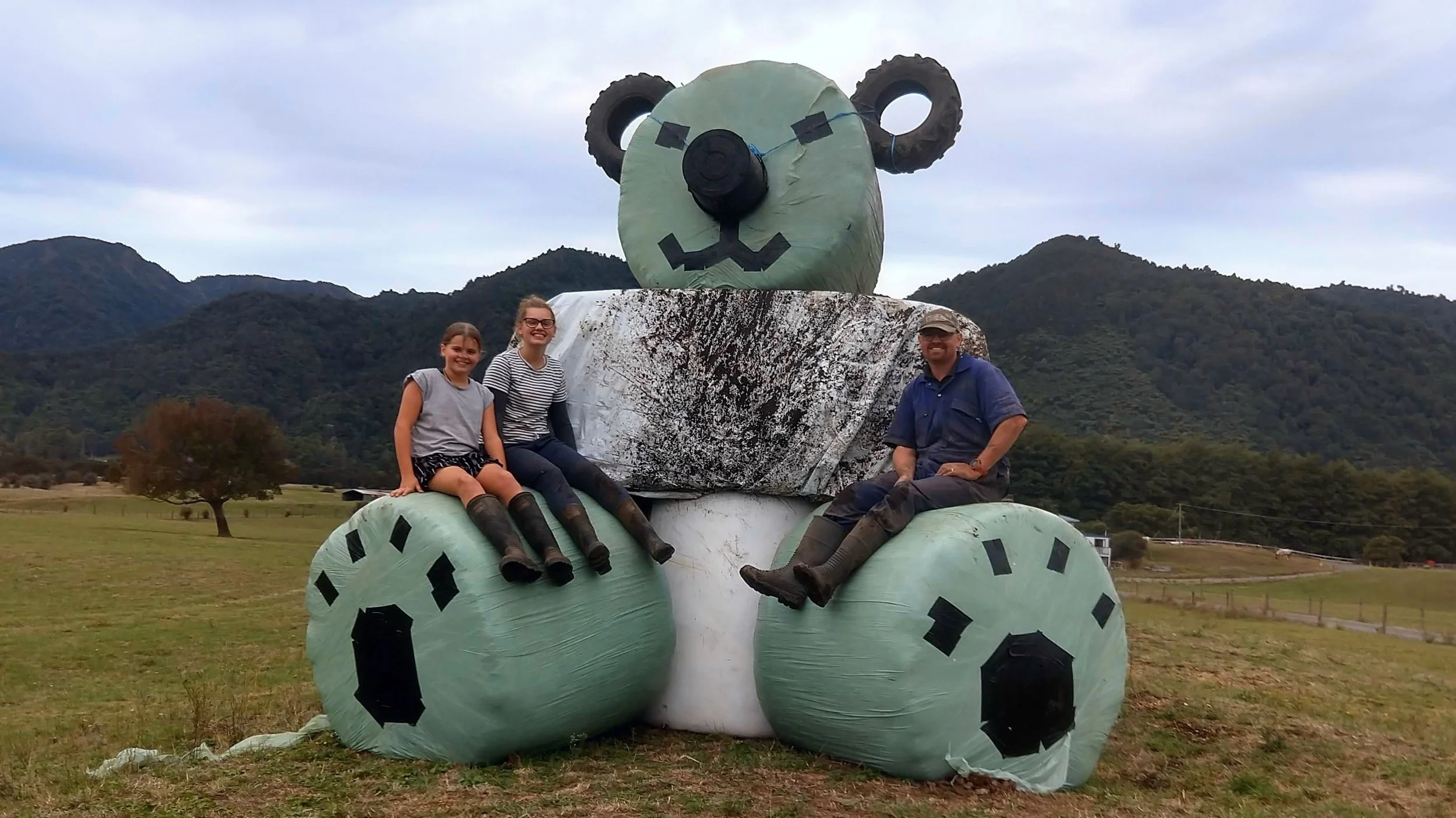
The silage bale analogy
Because there were a few farmers and ex-farmers in the room, the silage bale analogy felt like a good way to explain what happens when we hold onto old emotions for too long.
Our emotions can be a bit like grass.
When there is too much to deal with at once, we bale it up and store it away. Then we put a fence around it so no one can touch it. In farming, you do not want stock ripping into the bales before you are ready to feed them out, because they can wreck them.
Emotionally, we can do the same thing.
We bale up the hurt, betrayal, grief, fear, shame, disappointment, or anger. Then we protect it. We build a fence around it. We tell ourselves not to go near it. We do not want anyone else touching it either, because it feels too painful, too messy, or too dangerous.
But if a bale sits there too long, it can start to rot, break down, and smell.
Old emotions can do the same thing when they are stored away for years.
They do not just disappear. They sit there in the background and shape how we see ourselves, how we react, what we expect from people, and what we think is safe. Sometimes we even start building our identity around them.
We become the man who was hurt.
The man who was betrayed.
The man who cannot trust.
The man who always has to work hard.
The man who holds everything together.
The man who cannot let anyone get too close.
And then letting go of the bale can feel threatening, because a part of us wonders, “Who would I be without this?”
But there is another way to look at it.
A silage bale is not rubbish. It is stored nourishment. It is feed. It has value when it is unpacked and used in the right way.
Our old emotions can be like that too.
They may have been painful, but when we are ready to open them carefully, they can teach us something. They can show us what we needed, what we were protecting, what we were afraid of, and what we no longer need to keep carrying in the same way.
Once a bale is fed out, the memory of it is still there. You still know it existed. You still know what happened. But it is no longer sitting there as a big heavy object taking up space and needing to be protected.
That is often what healing looks like.
Not deleting the memory.
But changing the way we carry it.
Why familiar chaos can feel like love
We also talked about attachment, and why we can sometimes be drawn to people who are not necessarily good for us.
Sometimes it is not really the person we are attached to. It is the familiar feeling underneath.
Chaos can feel like chemistry when peace feels unfamiliar. Trying to fix someone can feel like love when our worth has been tied to being needed. The push-pull of connection and disconnection can feel exciting when a calm, safe relationship feels strange or even boring.
This does not mean anyone is bad or broken. It also does not mean one person is the problem and the other person is innocent. Most of the time, two people are bringing their own history, patterns, wounds, and coping mechanisms into the relationship.
But it does mean we need to be honest about what we are actually drawn to.
Are we drawn to love, or are we drawn to the chance to finally win the love we did not feel we had before?
Are we choosing connection, or are we repeating a pattern that feels familiar?
Are we staying because the relationship is healthy, or because leaving would force us to face a part of ourselves we have been avoiding?
These are not easy questions. But they are important ones.
Why change can feel unsafe
One of the biggest parts of the conversation was why we do not change, even when we can clearly see the pattern.
The simple answer is that change can feel unsafe.
Not because the new thing is actually bad, but because it is unfamiliar.
A healthier relationship can feel strange if chaos has been normal. Being supported can feel uncomfortable if we have always had to do everything ourselves. Having more money can feel unsafe if we unconsciously believe that wealthy people are selfish or dishonest. Being treated well can feel suspicious if we are used to having to earn love.
We may say we want things to improve, but when they do, something inside us can panic.
That is often called the upper limit. Life starts to get better. Things begin to work. We feel calmer, more loved, more successful, more supported, or more abundant. But because that level is unfamiliar, part of us does not know how to hold it.
So we sabotage it.
We pick a fight. We withdraw. We overspend. We create drama. We go back to an old habit. We convince ourselves it will not last anyway, so we may as well bring it down now.
Not because we truly want to suffer, but because the old pattern feels normal.
The work is learning to feel safe at the next level.
Safe in a healthier relationship.
Safe having more money.
Safe being supported.
Safe not having to fix everyone.
Safe being loved without chaos.
Safe being yourself without losing yourself to keep the connection.
Losing yourself to keep the relationship
A lot of men lose themselves in relationships because they are trying to avoid conflict, avoid abandonment, avoid rejection, or avoid feeling like they have failed.
So they adapt.
They keep the peace. They say yes when they mean no. They stop speaking up. They stop doing the things that matter to them. They become useful, needed, dependable, or emotionally unavailable, depending on what helped them survive in the past.
But slowly, they disappear from their own life.
Then one day they look around and wonder why they feel flat, angry, resentful, disconnected, or unsure of who they are.
The answer is not always to leave the relationship. Sometimes the answer is to come back to yourself inside the relationship.
To notice the loop.
To unpack the bale.
To question the familiar pull.
To learn how to feel safe with something healthier.
To ask, “What am I calling love, loyalty, or commitment, when it may actually be a familiar pattern I am afraid to let go of?”
A question to sit with
If this has brought something up for you, the question I would sit with is:
Where am I losing myself to keep a connection, and what familiar pattern am I afraid to let go of?
It may not be an easy question.
But it might be the beginning of finding yourself again.
A note about these reflections: These posts are inspired by the themes and patterns that arise in the group, but do not identify or repeat anyone’s personal story. Speak Up Cambridge is a space for honest conversation, not public exposure.
P.S. If this has brought something up for you, you do not have to work it all out on your own.
Sometimes it helps to have a space to slow down, look at what is sitting underneath the reaction, and make sense of the patterns that keep repeating.
I offer one-on-one sessions for men who are feeling stuck, overwhelmed, angry, flat, or unsure about what is next.
