
What Sits Underneath the Reaction?
When Anger Is Not Really About Anger
The light-switch metaphor for understanding pressure, overwhelm, control, and what sits underneath the reaction.
Sometimes anger is not really about the thing in front of us.
It might look like it is about the person who said the wrong thing, the job that is not going right, the partner who has not done what we hoped, or the plan that has suddenly changed. But often, there is more building underneath. It can be the pressure of trying to hold everything together, the exhaustion of carrying too much, or the feeling that we have to keep coping without letting anyone see that we are struggling.
Eventually, something small happens, and the reaction comes out. For some people, that reaction is anger. For others, it is shutting down, getting short with people, withdrawing, overthinking everything, or feeling flat and disconnected from life.
At a recent Speak Up Cambridge group, we talked about what can sit underneath those reactions. It brought up something I had to learn the hard way.
When I was dairy farming, some of the times I got the angriest were in the cowshed. The cows would not be flowing the way I thought they should, things would be taking longer than planned, someone might be falling behind, or the routine would be disrupted. Sometimes it was simply one of those days where nothing seemed to work as smoothly as it should.
In those moments, I would blame the cows for how angry I felt.
Looking back, that sounds pretty ridiculous. The cows were just being cows. More than that, animals pick up on the energy around them. The more worked up I became, the more unsettled they often became too, and the harder it was to get things flowing again.
At the time, though, I could not see what was actually happening underneath my anger. Something had moved outside of my control. The plan in my head was not working, I felt like I was falling behind, and the pressure was building quickly.
What I did not want to admit was that I needed help.
Somewhere inside me, asking for help felt like weakness. It felt like I should have been able to handle it, keep things moving, and work it out myself. But the truth was that I was often overwhelmed, feeling alone, and at times honestly wanting someone to come in and take over because I felt abandoned with it all.
Instead of being able to say, “I need a hand here,” or “I am getting overwhelmed,” it came out as anger.
That was the part I did not understand then. Anger was not the whole story. It was just the part everyone could see.
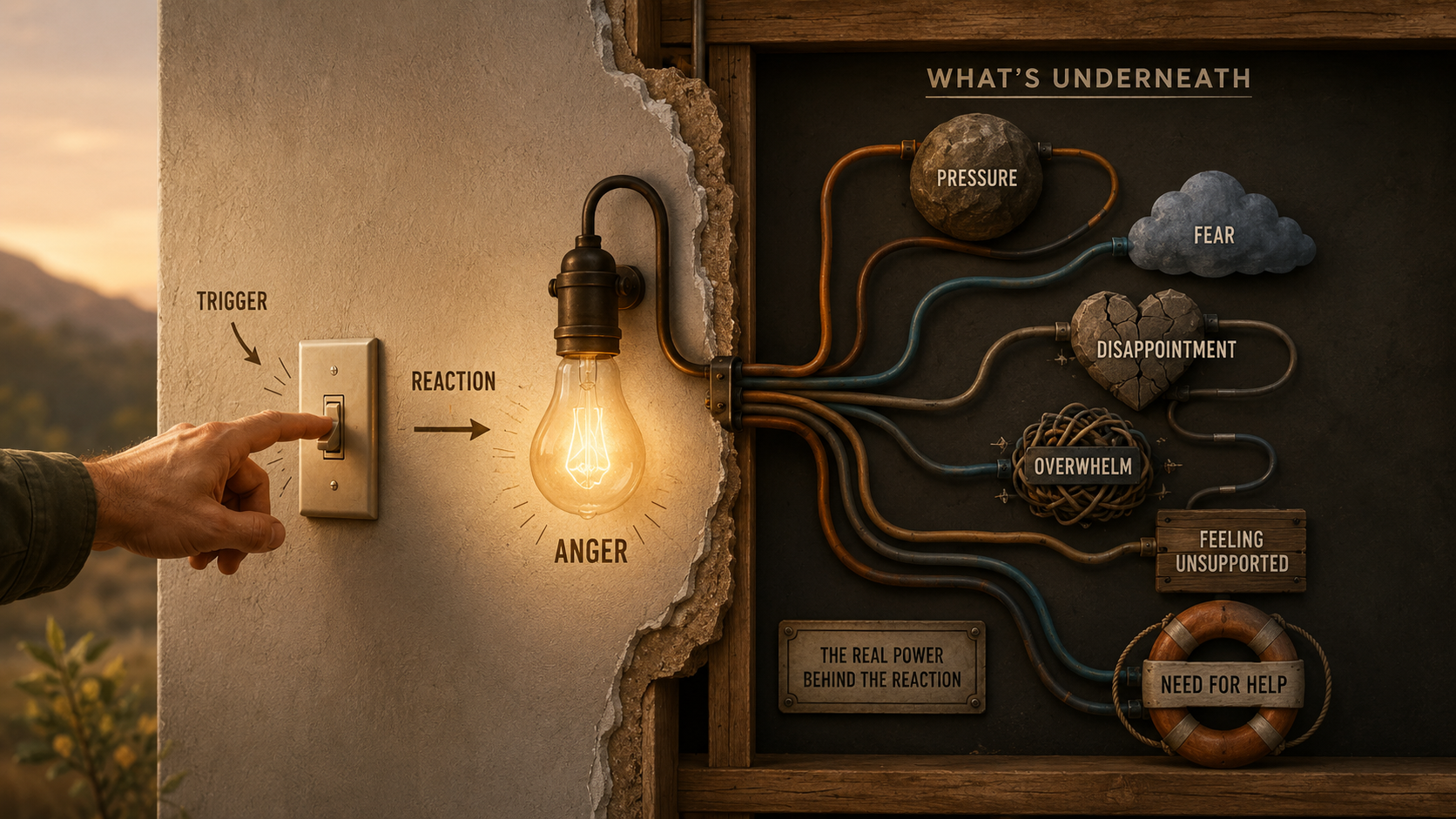
The light-switch metaphor
Think about a light coming on in a room.
The switch is the thing that gets flicked. It might be someone letting you down, a plan changing, work not going right, a partner saying something that hits a nerve, a job rejection, or another demand being added to an already full plate.
The light is the reaction that appears. It is the part other people see: anger, frustration, shutting down, getting sharp, withdrawing, feeling flat, or wanting to control everything around you.
But behind the wall is the circuit.
That circuit might include pressure, fear, disappointment, old hurt, feeling unsupported, feeling powerless, needing control, feeling like you have to carry everything yourself, or being scared that you will fail if you cannot keep up. The person or situation in front of us may flick the switch, but it is not always the whole reason the light comes on.
For me, that was a massive shift. As long as I blamed the cows, the staff, the job, or the situation, I stayed stuck. I gave all my power to what was happening outside of me, because I could not see what was being touched inside of me.
But when I started asking, “What is actually happening underneath this?” I began to see that the anger was trying to tell me something. I needed help. I needed to slow down. I needed to let go of the expectation that everything had to happen in a certain way, at a certain time, according to the plan I had already made in my head.
When holding it all together becomes the problem
A lot of us have learned to be the person who keeps going. We say yes when we really mean no. We try to make everyone else happy. We put our own needs at the bottom of the list and tell ourselves that we should be able to handle it.
From the outside, that can look like strength. But underneath, it can become exhausting.
When you do not feel able to ask for help, set a boundary, admit that you are struggling, or let people see what is really going on, the pressure has nowhere to go. It has to come out somewhere, and it might show up as anger, resentment, low mood, feeling stuck, loss of motivation, or not really knowing what you want anymore.
For some people, anger is what comes out. For others, it is withdrawal. For others, it is staying busy enough that there is never any space to feel what is actually going on. They may tell everyone they are fine while quietly carrying far more than they can handle.
The reaction is not proof that there is something wrong with you. Often, it is a sign that something in you has been trying to get your attention for a while.
The link between control and purpose
This is where the conversation about purpose comes in as well.
It is easy to think that purpose means having one clear plan, the right job, the right relationship, more money, or a life that finally feels sorted. There is nothing wrong with wanting those things. Most of us want life to feel more secure, meaningful, and enjoyable.
But when we become convinced that we need life to look a certain way before we can feel okay, the pressure starts to build again. We begin trying harder to control the outcome. We push, overthink, and tighten up, hoping that more effort will finally make life go the way we need it to.
Then, when life still does not go as planned, the disappointment can feel much bigger than the situation itself. A job rejection becomes, “There is something wrong with me.” A relationship ending becomes, “I will always be alone.” Not knowing what to do next becomes, “I am falling behind in life.”
That is often where people begin to feel overwhelmed, flat, disconnected, or unsure of their purpose. It is not necessarily because they have failed. Sometimes it is because they have been trying to carry too much, control too much, or force an answer before they have had the chance to listen to what life is actually showing them.
That does not mean every difficult experience has a neat explanation, and it does not mean we should pretend painful things are positive. Sometimes life is genuinely hard, and sometimes we need practical support, professional help, rest, or someone beside us while we work through it.
But it can still be useful to get curious.
Rather than only asking, “Why is this happening to me?” we can begin asking, “What is this showing me? What am I holding too tightly? What am I avoiding asking for? What do I actually need here?”
For me, purpose has not come from having every answer. It has come from getting more honest about what is underneath the reaction. It has come from noticing what keeps showing up, what drains me, what gives me energy, what I care about, and what I have lived through that may now help someone else.
A question to sit with
The next time the light comes on for you — whether that is anger, frustration, overwhelm, shutdown, or feeling low — it may be worth pausing for a moment and asking:
What is the circuit underneath this reaction trying to show me?
What pressure am I carrying? What am I trying to control? What am I afraid will happen if I let go? What do I actually need? And am I willing to ask for help before anger, shutdown, or low mood becomes the only thing people can see?
You are not broken for having the reaction. You may simply be carrying more than you have been able to name.
A note about these reflections: These posts are inspired by the themes and patterns that arise in the group, but do not identify or repeat anyone’s personal story. Speak Up Cambridge is a space for honest conversation, not public exposure.
P.S If this has brought something up for you, you do not have to work it all out on your own.
Sometimes it helps to have a space to slow down, look at what is sitting underneath the reaction, and make sense of the patterns that keep repeating.
I offer one-on-one sessions for people who are feeling stuck, overwhelmed, angry, flat, or unsure about what is next.
